Showing posts with label Lecture. Show all posts

Monday, January 24, 2011

Fair for Knowledge: Hair (January 30 at the Brooklyn Flea)


Fair for Knowledge: Hair

Featuring Laurel Braitman (historian of science), Barbara Cassin (philosopher and philologist), Cécile Guilbert (essayist), Justin E. H. Smith (philosopher), John Strausbaugh (author), and Sophie Wahnich (historian), seated at special tables designed by artist Gareth Long

An event organized by Cabinet and co-presented as part of Villa Gillet's "Walls and Bridges" series

Date: Sunday, 30 January 2011, 2–6 pm
Location: Brooklyn Flea, 1 Hanson Place (at Flatbush Avenue; map and directions here)
FREE. No RSVP necessary.

"Designed to encourage an informal, social, and open mode of learning, Cabinet's series of "fairs for knowledge" aims to create bridges between specialists and the general public by providing unusual venues for short one-on-one discussions between an expert and a member of the general public. In this first installment, six writers will be seated at special tables placed between the regular stalls of the Brooklyn Flea and be ready to engage the public in conversation on a topic that occupies our minds a great deal but is considered too lowly to be worthy of serious reflection—hair.

Come and brush up on “hair plucking” among anxious captive animals; Mary Magdalene’s hair as described in the Bible; fashion, hairdos, and underwear; hairlessness as a signifier of rationality in the history of philosophy; the exceptional hairstyles of rock stars; shaved women and the symbolic loss of power in the French revolution; and more!"

Tuesday, December 7, 2010

There Is a Policeman Inside All Our Heads: He Must Be Destroyed


Date: Friday, December 10, 2010, 8 pm
Location: The New School Theresa Lang Community and Student Center, Arnhold Hall, 2nd Floor, 55 W 13th St, New York

FREE. No RSVP necessary.

A co-presentation with the National Psychological Association for Psychoanalysis & the New School

Cabinet, The National Psychological Association for Psychoanalysis, and the New School present a screening of There Is a Policeman Inside All Our Heads: He Must Be Destroyed and Eight People Sipping Wine in Kettering, parts 3 and 4 of The Century of the Self, the extraordinary BBC documentary on the intertwined histories of Sigmund Freud, modern consumerism, and representative democracy. At its heart is the idea that public relations and politicians have used Freud's theories to engineer a society of consent.

The screening will be preceded by an introduction by George Prochnik, Cabinet contributor and author of Putnam Camp: Sigmund Freud, James Jackson Putnam, and the Purpose of American Psychology (2006) and In Pursuit of Silence: Listening for Meaning in a World of Noise (2010). It will be followed by an open discussion with psychoanalyst Martin Bergmann, who is a participant in the documentary.

Parts one and two of the documentary (Happiness Machine and The Engineering of Consent,) were screened on November 12, with a short introduction by Jane Kupersmidt, faculty at the National Psychological Association for Psychoanalysis and member of the Freudian Society. A transcript of the introduction is available here. The first two parts of the The Century of the Self can be seen online here.

Sunday, September 26, 2010

Book Reading and Discussion: Moustafa Bayoumi, Max Blumenthal, Arun Gupta, Rashid Khalidi, on the Impact of the Gaza freedom Flotilla


Panel Discussion with Max Blumenthal, Moustafa Bayoumi, Arun Gupta, Adam Horowitz, Rashid Khalidi, Alia Malek and Phil Weiss on the Impact of Gaza Freedom Flotila Attack.

Tuesday, September 28, 2010
7:00 pm at Alwan for the Arts

Free and Open to the Public

This event is sponsored by OR Books and Haymarket Books and is a launch of the Haymarket Books (http://www.haymarketbooks.org/) edition.

Midnight on the Mavi Marmara
The Attack on the Gaza Freedom Flotilla and How It Changed the Course of the Israel/Palestine Conflict
Moustafa Bayoumi, Editor

* * * * *

Eastern Mediterranean, Monday, May 31st, 2010, 4.30am: Israeli commandos, boarding from sea and air, attack the six boats of the Gaza Freedom Flotilla as it sails through international waters bringing humanitarian relief to the beleaguered Palestinians of Gaza. Within minutes, nine peace activists are dead, shot by the Israelis. Scores of others are injured. The 700 people on board the ships are arrested before being transported to detention centers in Israel and then deported.

Within hours, outrage at Israel’s action echoes around the world. Spontaneous demonstrations in Europe, the United States, Turkey, and Gaza itself denounce the attack. Turkey’s prime minister describes it as a “bloody massacre” and “state terrorism.” Lebanon’s prime minister calls it “a dangerous and crazy step that will exacerbate tensions in the region.”

In these pages, a range of activists, journalists, and analysts piece together the events that occurred that May night, unpicking their meanings for Israel’s illegal, three-year-long blockade of Gaza and the decades-long Israel/Palestine conflict more generally. Mixing together first-hand testimony, documentary record, and illustration, with hard-headed analysis and historical overview, Midnight on the Mavi Marmara reveals why the attack on Gaza Freedom Flotilla may just turn out to be Israel’s Selma, Alabama: the beginning of the end for an apartheid Palestine.

CONTRIBUTORS: Ali Abunimah, Eyad Al Sarraj, Lamis Andoni, Omar Barghouti, George Bisharat, Max Blumenthal, Noam Chomsky, Marsha B. Cohen, Juan Cole, Murat Dagli, Jamal Elshayyal, Sümeyye Ertekin, Norman Finkelstein, Neve Gordon, Glenn Greenwald, Arun Gupta, Amira Hass, Nadia Hijab, Adam Horowitz, Rashid Khalidi, Stephen Kinzer, Iara Lee, Henning Mankell, Paul Larudee, Gideon Levy, Alia Malek, Lubna Masarwa, Mike Marqusee, Yousef Munayyer, Ken O’Keefe, Daniel Luban, Kevin Ovenden, Ilan Pappé, Doron Rosenblum, Sara Roy, Ben Saul, Adam Shapiro, Raja Shehadeh, Henry Siegman, Ahdaf Soueif, Raji Sourani, Richard Tillinghast, Alice Walker, Stephen M. Walt, Philip Weiss, and Haneen Zoabi.

Alwan for the Arts

16 Beaver Street (between Broad and Broadway), 4th floor,
New York, NY 10004
(646) 732-3261

Saturday, September 18, 2010

Performing Idea, Performance Matters

Adrian Heathfield, Co-Director of Performing Idea

Performing Idea public programme

2nd-9th October 2010
Whitechapel Gallery and Toynbee Studios, London

Performing Idea is a programme of events at Whitechapel Gallery and Toynbee Studios that investigate the shifting relations between performance practice and discourse, event and writing.

The public programme comprises a set of workshops led by three internationally acclaimed artists; a five day symposium with leading writers, thinkers and artists; a sound and video archive of seminal performance lectures; and a series of new performance lectures and redos by UK and international artists.

With contributions from: Janine Antoni, Ron Athey, Anne Bean, Wafaa Bilal, Maaike Bleeker, Silvia Bottiroli, Jonathan Burrows, Gavin Butt, Cabula 6, Augusto Corrieri, Robin Deacon, Rose English, Tim Etchells, Matthew Goulish, Adrian Heathfield, Hannah Hurtzig, Shannon Jackson, Janez Janša, Joe Kelleher, Tellervo Kalleinen, Lois Keidan, Ong Keng Sen, Bojana Kunst, Boyan Manchev, Fred Moten, Rabih Mroué, Giulia Palladini, Owen Parry, Peggy Phelan, Heike Roms, Lara Shalson, and Julie Tolentino.


To make a booking for the Performing Idea public programme click on How to book.

About Performing Idea

At a time when performance and live art have increased visibility in the worlds of art, theatre, dance and the academy, Performing Idea asks how such experimental performance forms signal changes in understandings of both art and the world beyond. The event pursues the multiple ways in which contemporary artists and thinkers have come to refashion not only understandings of art, but also the ways in which we produce and value the world of ‘ideas’.

Performing Idea seeks to explore the consequences for traditional understandings of knowledge when contemporary art actions, immaterial performances and social exchanges are routinely presented as valuable ways of knowing. What challenges do such practices present for the keepers, institutions and edifices of knowledge: the intellectuals and art arbiters, the academic institutions, and archives and libraries? Might the current forms of critical practice – of ‘creative research’ and ‘discursive events’ – represent new models of knowledge exchange and thoughtful relation, and suggest something more provisional and trans-active in the ways in which we might hold something dear?

Performing Idea is the first year of Performance Matters, a three-year creative research project rethinking why performance matters through the matter of performance. At a time when performance and live art have increased visibility in the worlds of art, theatre, dance and the academy, Performing Idea asks how such experimental performance forms signal changes in understandings of both art and the world beyond through a set of critical and creative exchanges and research processes.

For full details of the Performing Idea public programme and
information about the Performance Matters project, please visit:
http://www.thisisperformancematters.co.uk/activities.html

Bookings:
- The Performing Idea Symposium (5th to 9th October, 3pm to 7.30pm)
and evening programme of performance lectures and redos (4th to 9th October,
8.30pm) take place at Toynbee Studios and bookings must be made through Artsadmin
here.


Spaces are limited - early booking is advised.

Monday, June 14, 2010

Reading Group and Discussion: Art, Criticism, and Its Markets

Wednesday 06.16.10 -- Art, Criticism, and Its Markets

CONTENTS:

1. About this Wednesday

2. More on Isabelle Graw

3. Readings

4. Upcoming Readings


___________________________________________________
1. About this Wednesday

What: Reading Discussion
Where: 16Beaver Street, 4th Floor
When: Wednesday 06.16.10 at 7:15 pm
Who: Free and open to all

Over the last 20 or 30 years, there has been an increasing amount of criticism written which is directed at the economy or market of art. This growing interest on the part of critics has mirrored the burgeoning market around art. And even today, in the midst of a financial depression in many parts of the world, art is increasingly seen as an integral part of 'investment portfolios' and considered a 'safe haven' for nervous investors. Even 'well intentioned' efforts which attempt to protect the interests of artists, through funds or pension trusts, only seem to
reinforce the ever increasing pace of the financialization or securitization of art.

This Wednesday, we would like to invite those who might be interested in exploring the interrelations between art, money, and criticism to attend what will be the first meeting of a focused reading group on the subject.

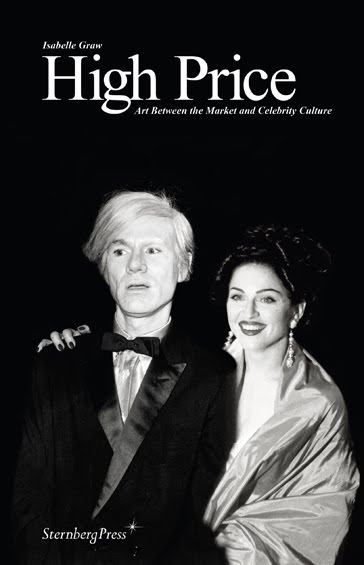
The reading group is being organized by Anastasiya Osipova and Zac Dempster and they will use Isabelle Graw's book "High Price: Art Between the Market and Celebrity Culture" as a point of reference and departure.

The book investigates what an art market does in relation to the artists who strategize within it. Graw begins by narrating through Gustave Courbert's exploits in prison and his heroic exclusion from Salon de Paris into collectors homes. Could this serve as precedent for contemporary
artist in their criticisms of the institution while fortifying their cultural value? Some contemporary cases are those of the New York American Fine Arts, Co gallery, Andrea Fraser and Merlin Carpenter, Andy Warhol, Damien Hirst, Julien Schnabel, Jeff Koons, Richard Prince, Yves Klein…

Among key questions that will be addressed through these discussions is a position of criticism vis-à-vis art, which is already seen as both an epistemological object and an indexical expression of market value (not unlike money). Does this status of art reify critical texts as well?

If the so-called art-market is not to be described as a reservoir of phantasms, if the story we could tell of it is not to be a ghost mystery story, what genre would be appropriate?

It is our hope to meet the limitations of this self-reflexive text by an exegesis that will include artist press releases, gallery websites, Facebook pages, photographs, blog posts, art magazine and journal reviews, art auction details, etc. As though following on Twitter the question "to
what degree can contemporary writers profit off the vocabulary this text offers? In what fields and by the use of what empty signifiers?"

Anastasiya and Zac will begin the evening by introducing how they arrived at the idea for this reading group, and then we will begin what will be the first of several sessions of readings and discussions.

___________________________________________________
2. More on Isabelle Graw

Isabelle Graw is Professor for Art Theory and Art History at Staatliche Hochschule für Bildende Künste (Städelschule) in Frankfurt am Main, Germany, where she co-founded the Institute of Art Criticism. She is an art critic and co-founder of Texte zur Kunst in Berlin -- Sternberg Press's website. Graw now lives in Berlin, but was associated with a Cologne group of artists that circled around Martin Kippenberger.

_________________________________________________
3. Readings

For the introductory meeting we will look at the following texts:
Isabelle Graw, foreword to High Price
http://sduk.us/beaver/PDF/graw_innen_pt1.pdf

Michel Foucault “What is Critique?”
http://sduk.us/beaver/PDF/foucault_what_is_critique.pdf

Dietrich Dietrichson “On (Surplus) Value in Art”
http://sduk.us/beaver/PDF/dietrichson.pdf

Barbara Rose "The Auction is the Action"
http://sduk.us/beaver/PDF/rose_auction.pdf

and view a promotional video from Artprice, a French company that
serves as the largest database of the art sales records.
http://www.youtube.com/watch?v=kCyKRTX5bdg

___________________________________________________
4. Upcoming Readings

2nd meeting reading list:
Isabelle Graw, Chapter One of High Price

Jean-Joseph Goux “Figurative Standards: Gold and the Phallus” from
Symbolic Economies

Georges Bataille & numismatics (abstracts from Denis Hollier Against
Architecture: Writings of Georges Bataille)

“Art and its markets: a roundtable discussion” , Artforum, April 2008
http://findarticles.com/p/articles/mi_m0268/is_8_46/ai_n31487375/

Seth Price “Dispersion”
http://www.distributedhistory.com/Dispersion2008.pdf

Pierre Bourdieu, abstracts from The Rules of Art.

“The History of Money” videos:
http://www.youtube.com/watch?v=D0IJCGuNtqk

(possibly: Georg Simmel The Philosophy of Money)

__________________________________________________
16 Beaver Group
16 Beaver Street, 4th fl.
New York, NY 10004

for directions/subscriptions/info visit:
http://www.16beavergroup.org

TRAINS:
4,5 Bowling Green
R,W Whitehall
2,3 Wall Street
J,M Broad Street
1,9 South Ferry

Tuesday, March 30, 2010

AFTER THE GOOD LIFE, AN IMPASSE: Notes on the Cinema of Precarity


The Center for the Study of Gender and Sexuality at New York University
and
the Barnard Center for Research on Women at Barnard College
present

A lecture by Lauren Berlant

AFTER THE GOOD LIFE, AN IMPASSE:
Notes on the Cinema of Precarity

April 8, Thursday
7 to 8:30 PM

Lauren Berlant, English, University of Chicago

"After the Good Life" works with two films of Laurent Cantet [Ressources humaines/Human Resources (1999) and L'Emploi du Temps/Time Out (2001)] to engage the new affective languages of the contemporary economic atmosphere across Europe: languages of anxiety, contingency, and precarity that take up the space where social democracy, upward mobility, and meritocracy used to reign. What happens to optimism when futurity splinters as a prop for getting through life? How to understand the emergence of this felt crisis in relation to transformations of the good life fantasy? The question reaches broadly, but the archive focuses on a variety of crises in the professional classes, which no longer can delegate precarity to the poor or the citizen sans papiers; its interest is in exploring how a new cinema of precarity stages the end of an era of social obligation and belonging by focusing, microhistorically, on what happens to manner and manners.

Lauren Berlant is George M. Pullman Professor of English at the University of Chicago. Developing concepts of affective publics since The Anatomy of National Fantasy: Hawthorne, Utopia, and Everyday Life (Chicago, 1991), she has completed a trilogy on national sentimentality, with The Queen of America Goes to Washington City: Essays on Sex and Citizenship (Duke, 1997), and The Female Complaint: the Unfinished Business of Sentimentality in American Culture (Duke, 2008). She is also editor of Intimacy (Chicago, 2000), Compassion (Routledge, 2004), On the Case(forthcoming) and, with Lisa Duggan, Our Monica, Ourselves (2001). This talk is from her next book, Cruel Optimism.

NYU Lipton Hall
108 West 3rd Street
between MacDougal and Sullivan Streets

Seating is on a first-come basis; no RSVPs.

This event is free and open to the public. Venue is wheelchair accessible, but please let us know in advance if you need access.

If you need sign language interpretation services or other accommodations, please let us know as soon as possible.

For more information, please call 212-992-9540, email csgs@nyu.edu, or visit http://www.csgsnyu.org .

Friday, March 12, 2010

Summer 2010: Art and Resistance

Jesusa Rodriguez. photo by Julio Pantoja

The Hemispheric Institute of Performance and Politics

Presents:

Summer 2010: Art and Resistance

San Cristobal de las Casas, Mexico

July 19–August 6, 2010

Taught by Diana Taylor, Jesusa Rodríguez (Resistencia Creativa, Mexico), and Lorie Novak

This course explores the many ways in which artists and activists use art (performance, mural paintings, graffiti, writing, music) to make a social intervention in the Americas. We begin the course by examining several theories about art and activism (from Plato and Aristotle to Brecht, Boal, Buenaventura, Ngugi wa Thiong’o, and Foucault, among others) and then focus on issues of agency, space, event, and audience in relation to major political movements (revolution, dictatorship, democracy, globalization, and human rights) as seen in the work of major practitioners. Jesusa Rodriguez will lead an intensive one-week performance workshop as part of the course. Lorie Novak will discuss the use of the Internet as a site for activism, doumentation, and research, and will assist students in conceptualizing and realizing web-based projects. Performances, video screenings, guest lectures, and visits to FOMMA, Chiapas Media Project, a Zapatista community and other activist projects will provide an additional dimension to the questions raised by the theoretical readings and discussions. Students are encouraged to explore possibilities for practice-based research, develop their own sites of investigation, and share their work in a final presentation.

Students from all member institutions of the Hemispheric Institute are encouraged to apply. NYU students can take the course for 4 pts of graduate credit through the Department of Performance Studies, and students from other institutions can take the course for credit as independent study in their home universities. Students from non-member institutions will be considered for admission, though priority will be given to graduate students from member institutions.

Although bilinguality (English-Spanish) is a plus, it is not required. Students are encouraged to bring laptops and digital cameras to use for their projects.

Lab fee $1000

A lab fee will apply to all—$1000 for students in the U.S. Canada, and Europe, and $250 for those in Latin America. While housing and travel costs are separate, the Hemispheric Institute is negotiating very reasonable costs for room and board. All local expenses (performances, lectures, travel to local sites, etc., will be covered by the lab fee).

Download Application

English
Español
The deadline for applications is May 1, 2010.

Download the announcement (PDF)

English
Español

Monday, March 1, 2010

Joseph Keckler Performance/Artist Talk at New York University

Joseph Keckler by Gian Maria Annovi

NYU's Department of Performance Studies presents the first event in this year's Performance Studies Lecture Forum: JOSEPH KECKLER.

Joseph Keckler is a performance artist, writer, and singer. His work explores the gap between theater and life, establishing unexpected connections between art, identity, and contemporary alienation. In his performances, he fuses story-telling with an elastic, classically trained, and chameleonic three-octave voice to create one-person fantasias which bring the banal to operatic intensity. Keckler’s pieces have been featured on NPR, The Sundance Channel, and Transform.org, and he has performed at HERE, Living Theater, Galapagos Art Space, London’s Duckie, Abron Arts Center, SF MOMA, The Player’s Club, Dixon Place, The Guggenheim, as well as other venues in New York City, nationally, and abroad.

Please join us on TUESDAY MARCH 2ND, 7-8:30PM to see Joseph Keckler discuss and perform his work.

Located in the Performance Studies Studio at Tisch School of the Arts (721 Broadway, 6th Floor)

FREE. Reception (with free food and drinks!) following talk.

No reservations required for NYU students and faculty.
Non NYU-affiliated folks please RSVP to:
PSLectures@gmail.com

The Performance Studies Lecture Forum is a series of evening events featuring preeminent scholars and practitioners in the fields of art and performance. The events are presented on weekday evenings in the department's studio space, and are designed to create an informal and intimate setting for intellectual exchange among artists, students and scholars.

Monday, February 1, 2010

Leda Martins Talk: How Can We Remember the Bees and the Beats? Memory, Death and Disappearance in Brazilian Ritual Performances


How Can We Remember the Bees and the Beats? Memory, Death and Disappearance in Brazilian Ritual Performances

A lecture in English by Leda Martins

Thursday, February 4, 2010 6pm

Hemispheric Institute of Performance and Politics
20 Cooper Square, 5th Floor
New York, NY

Leda Martins is a poet, playwright, and professor of Literature at the Universidade Federal de Minas Gerais in Belo Horizonte, Brazil. Her research focuses on the relationship between performance and memory, particularly in Afro-Brazilian traditions.

Drawing on her concepts of "Spiral Time" and "Oraliture," Professor Martins will examine the ritual ceremonies of the Afro-Brazilian Congados and of the indigenous Maxakalí. Analyzing the interconnections between death, image, and the ancestral, she explores these performances as practices of embodied memory through which these communities struggle against forgetting and disappearance.

Friday, January 29, 2010

Shereen El Feki: Pop culture in the Arab world


My colleague Hazem Azmy forwarded the link to this video of a short talk by Shereen El Feki on "Pop culture in the Arab world". Although she seems to be concentrating primarily on the Islamic Arab world... Arab Christians only appear in her talk as a too-sexy pop-culture counter-example, something I am still thinking about (I am a Maronite Catholic and, in my particularly Mediterranean brand of Christianity there nothing wrong with a hot Lebanese Pin-up girl) But of course I understand the potential Islamic objections to this sort of entertainment and perhaps the need for alternatives.

So, for me at least, there are more questions here that need to be unpacked... especially in terms of the way that religious paradigms shape cultural expressions. But I really love her point about the "mesh 0f civilizations", which is a much more realistic description of the way culture actually flows back and forth irrespective of national borders, religious proscriptions and/or political expediencies. I wish she'd included a historical element to this point, especially since Arab and Islamic innovation, which bled into Europe through trade helped pull Europe out of its Dark Ages...

I have included the transcript below.

Transcript:

"Hello everyone. Because this is my first time at TED, I've decided to bring along an old friend to help break the ice a bit. Yes. That's right. This is Barbie. She's 50 years old. And she's looking as young as ever. (Laughter) But I'd also like to introduce you to what may be an unfamiliar face. This is Fulla. Fulla is the Arab world's answer to Barbie. Now, according the proponents of the clash of civilizations, both Barbie and Fulla occupy these completely separate spheres. They have different interests. They have divergent values. And should they ever come in contact ... well, I've got to tell you, it's just not going to be pretty. My experience however, in the Islamic world is very different. Where I work, in the Arab region, people are busy taking up Western innovations and changing them into things which are neither conventionally Western, nor are they traditionally Islamic. I want to show you two examples. The first is 4Shbab. It means "for youth" and it's a new Arab TV channel.

(Video): Video clips from across the globe. The USA. ♫ I am not afraid to stand alone ♫ ♫ I am not afraid to stand alone, if Allah is by my side ♫ ♫ I am not afraid to stand alone ♫ ♫ Everything will be all right ♫ ♫ I am not afraid to stand alone ♫ The Arab world. (Music) ♫ (Urdu) ♫

Shereen El Feki: 4Shbab has been dubbed Islamic MTV. Its creator, who is an Egyptian TV producer called Ahmed Abou Haïba, wants young people to be inspired by Islam to lead better lives. He reckons the best way to get that message across is to use the enormously popular medium of music videos. 4Shbab was set up as an alternative to existing Arab music channels. And they look something like this.

(Music Video featuring sexy girl writhing)

That, by the way is Haifa Wehbe. She's a Lebanese pop star and pan-Arab pin-up girl. In the world of 4Shbab, it's not about bump and grind. But it's not about fire and brimstone either. It's videos are intended to show a kinder, gentler face of Islam, for young people to deal with life's challenges. Now, my second example is for a slightly younger crowd. And it's called "The 99." Now, these are the world's first Islamic superheros. They were created by a Kuwaiti psychologist called Nayef Al Mutawa. And his desire is to rescue Islam from images of intolerance, all in a child-friendly format. "The 99," the characters are meant to embody the 99 attributes of Allah, justice, wisdom, mercy, among others. So, for example, there is the character of Noora. She is meant to have the power to look inside people and see the good and bad in everyone. Another character called Jami has the ability to create fantastic inventions. Now, "The 99" is not just a comic book. It's now a theme park. There is an animated series in the works. And by this time next year the likes of Superman and Wonder Woman will have joined forces with "The 99" to beat injustice wherever they find it. "The 99" and 4Shbab are just two of many examples of this sort of Islamic cross-cultural hybridization. We're not talking here about a clash of civilizations. Nor is it some sort of indistinguishable mash. I like to think of it as a mesh of civilizations, in which the strands of different cultures are intertwined (emphasis mine).

Now, while 4Shbab and "The 99" may look new and shiny, there is actually a very long tradition of this. Throughout its history has borrowed and adapted from other civilizations both ancient and modern. After all it's the Quran which encourages us to do this. "We made you into nations and tribes so that you could learn from one another." And to my mind, those are pretty wise words, no matter what your creed. Thank you. (Applause)"


Bio:
"Shereen El Feki is based in Cairo, where she works on issues related to health and social welfare in the Arab region. Half-Egyptian, half-Welsh, Shereen was brought up in Canada. She started her professional life in medical science, with a PhD in molecular immunology from the University of Cambridge, and later worked as Healthcare Correspondent at The Economist magazine.

In recent years, Shereen has re-oriented her career towards the Arab world. While she has worked in regional media, as a presenter with the Al Jazeera Network, and continues to write on social issues in the Arab world, her passion lies in the many projects in which she is involved which aim to better understand, and surmount, the social challenges facing Arabs, particularly young people."

Friday, January 22, 2010

Screening and Discussion: A Road to Mecca: The Journey of Muhammad Asad. Discussion with Talal Asad and Joseph Massad


Screening and Discussion: A Road to Mecca: The Journey of Muhammad Asad. Discussion with Talal Asad and Joseph Massad

Wed, January 27, 2010 7:00 pm at Alwan for the Arts

Georg Misch Austria, 2009, 92 minutes, Color, Digital

Free and Open to the Public

In the early 1920s Leopold Weiss, a Viennese Jew, alienated by the materialism and spiritual emptiness of the West, travelled to the Middle East, visiting Jerusalem, Egypt, the Transjordan and Saudi Arabia. After studying the Koran, he left his Jewish roots behind, converted to Islam and changed his name to Muhammad Asad.

Asad (1900-1992) became one of the most important Muslims of the 20th century, spreading its message of peace and brotherhood as a journalist and author of books such as Islam at the Crossroads, The Principles of State and Government in Islam and his autobiography, The Road to Mecca. He served as an advisor to the royal court of Saudi Arabia and was a co-founder of Pakistan and its Ambassador to the UN.

A ROAD TO MECCA traces his spiritual journey, from the Arabian desert to Ground Zero, visiting the places where Asad lived and travelled. Archival footage and photos and excerpts from Asad's writings are blended with contemporary interviews with writers, historians, scholars, and his friends and associates, revealing Asad's legacy as a modern theological thinker.

In portraying the lifelong evolution of the philosophy of Muhammad Asad, who sought to be a mediator between East and West, A ROAD TO MECCA provides a portrait of contemporary Islam, challenging deeply rooted Western prejudices by revealing the distance between fundamentalist beliefs that support terrorism and the core beliefs of a profoundly humane religion.

“Fascinating... the film presents different viewpoints from a moderate middle ground to fundamentalist takes on the larger conflict in the Middle East... The history of Asad and his mental and physical journey are used to give the viewer a new insight into the current attitude and understanding of religion.” —Cecilie Bolvinkel, Dox Magazine


Talal Asad, son of Mohammed Asad, is Distinguished Professor of Anthropology at the Graduate Center of the City University of New York. His publications include On Suicide Bombing (Columbia University Press, 2007), Formations of the Secular (Stanford University Press, 2003), Genealogies of Religion (Johns Hopkins University Press, 1993), and a number of influential articles, including “On Re-reading a Modern Classic: W.C. Smith's The Meaning and End of Religion,” History of Religions (2001). Asad is a member of the SSRC working group on religion, secularism, and international affairs.

Joseph A. Massad is associate professor of modern Arab politics and intellectual history at Columbia University. He is the author of Colonial Effects: The Making of National Identity in Jordan; The Persistence of the Palestinian Question: Essays on Zionism and the Palestinians and Desiring Arabs.

"Fascinating... informative... a well-judged combo of travelogue and biopic... a fine piece of anthropology, worthy of the dedication it copies from Asad's translation of the Koran: 'For people who think.'"—Alissa Simon, Variety


"Lively, entertaining and very topical. A most astounding perspective on multicultural identities."—Der Falter

"A tactful and astute portrait."—Kleine Zeitung

Alwan for the Arts

16 Beaver Street (between Broad and Broadway), 4th floor,
New York, NY 10004
(646) 732-3261

Thursday, January 21, 2010

Tonight: A Report from Gaza & the West Bank The Gaza Freedom March and Beyond

Gaza Swimming Pool by Latuff

Tonight: A Report from Gaza & the West Bank The Gaza Freedom March and Beyond

Date: Thursday, January 21st, 2010 at 6:30pm
Location: Judson Memorial Church
Address: 55 Washington Square South, NY, NY 10012
(http://maps.google.com/maps?f=q&hl=en&q=55+Washington+Square+S,+New+York,+NY)

Speakers:
Ali Abunimah - co-founder Electronic Intifada: The Gaza Freedom March and Beyond
Michael Ratner - president Center for Constitutional Rights: Report from Cairo and the West Bank
Fida Qishta - journalist and filmmaker from Gaza
Jenna Bitar - student Hunter College H.S.: A Student Perspective

Admission at the door $10, Students $5 - none turned away

For more information call 917-912-2597 or 212-979-1381

Sponsors: Gaza Freedom March, Adalah-NY, Brooklyn for Peace, Codepink, Committee for the Open Discussion of Zionism, Jews Say No, Jewish Voice for Peace, Middle East Crisis Response, Wespac Tomorrow, January 22nd Ali Abunimah Speaks on: Global Grassroots Activism & the Gaza Freedom March

Tomorrow Night: 1300 People, 43 countries, 1 aim: Lift the Siege on Gaza

Date: Friday, January 22nd, 2010 at 2:15pm
Location: Earl Hall Auditorium (2nd Floor), Columbia University
Address: 2980 Broadway, NY, NY 10127
RSVP: recommended via Facebook: http://www.facebook.com/event.php?eid=256061418577&ref=mf

Ali Abunimah, author of “One Country: A Bold Proposal to End the Israeli-Palestinian Impasse” and co-founder of the Electronic Intifada (EI), which is one of the primary news media resources that offers sound analysis and refreshing perspective on the Israel-Palestine conflict, will speak on his experience on the March, grassroots activism, and the current state of the "peace process."

ABOUT the Gaza Freedom March (GFM):

The Global grassroots initiative inspired by Gandhi/Mandela aims to break the blockade of Gaza.

The Gaza Freedom March that will take place in Gaza on December 31 is an historic initiative to break the siege that has imprisoned the 1.5 million people who live there. Conceived in the spirit of Mahatma Gandhi, Nelson Mandela and nonviolent resistance to injustice worldwide, the march will gather people from all over the world to march—hand in hand—with the people of Gaza to demand that the Israelis open the borders.

Marking the one-year anniversary of the December 2008 Israeli invasion that left over 1,400 dead, this is a grassroots global response to the inaction on the part of world leaders and institutions. Over 1,000 international delegates from 42 countries have already signed up and more are signing on every day. Participants include Pulitzer Prize winning author Alice Walker, leading Syrian comedian Duraid Lahham, French Senator Alima Boumediene–Thiery, author and Filipino Parliament member Walden Bello, former vice president of European Parliament Luisa Morgantini from Italy, President of the U.S. Center for Constitutional Rights Attorney Michael Ratner, Japanese former Ambassador to Lebanon Naoto Amaki, French hip-hop artists Ministere des Affaires Populaires, and 85-year-old Holocaust survivor Hedy Epstein.

Also marching were families of three generations; doctors; lawyers; diplomats; 70 students; an interfaith group that includes rabbis, priests and imams; a women's delegation; a veterans group; and Palestinians born overseas who have never seen their families in Gaza.

This event is sponsored by the Arab Student Association at SIPA, TURATH, Adalah-NY, Codepink, MSA and the Grassroots Policy Network.

Co-sponsored by the Columbia Coalition Against War, Students for a Democratic Society, ISO, and Al-Awda NY.

Visit us on line at www.adalahny.org

Saturday, January 2, 2010

Discussion and Exhibition: "Darcy Lange: The Art of Teaching"

Darcy Lange, from Study of Three Birmingham Schools, UK, 1976.
Courtesy Darcy Lange Estate and Govett-Brewster Art Gallery.­

Date: January 7, 2010, 7–9 pm
Location: Cabinet, 300 Nevins Street, Brooklyn, NY
FREE; no RSVP necessary

Jeff Dolven and Simon Critchley will host a discussion on the relationship between pedagogy and art by showing segments of videos from Cabinet’s current exhibition of work by New Zealand artist Darcy Lange (1946–2005). In the 1970s, Lange took his video camera into schools in Birmingham and Oxfordshire to record the daily business of the classroom, and then put teachers and students on camera again as they watched the record he had made. The result is a penetrating and sometimes uncomfortable study—across a wide range of schools and social classes—of the strange combination of ordinariness and performance that occurs in every classroom. The panel will consider pedagogy as a work of art, and look beyond Lange’s work to the surge of interest in didacticism as a mode and motive for contemporary artists.

ABOUT THE PARTICIPANTS

Simon Critchley is a philosopher who teaches at the New School. His books include The Book of Dead Philosophers (Granta, 2008) and Infinitely Demanding (Verso, 2007)

Jeff Dolven
teaches English at Princeton University, and is the author of Scenes of Instruction (Chicago, 2007). With D. Graham Burnett, he organizes the series Poetry Lab at Cabinet.

The exhibition “Darcy Lange: Work Studies in Schools,” curated by Mercedes Vicente, draws from a series of videos by New Zealand artist Darcy Lange (1946–2005) which examine the processes of teaching and learning. In 1976, Lange videotaped a number of classrooms at three schools in the English city of Birmingham, carefully choosing institutions that would represent different social classes. Focusing on the teaching of art, history, and science, Lange first filmed each class in action. Afterwards, he would watch the tapes with the teachers and then the students, each time recording their reactions. The following year, Lange continued the project, this time in four Oxfordshire schools. Lange saw his tapes as material for “research,” an “educational process” in which the reactions of his subjects to the footage were just as important as the original films.

About Darcy Lange
A graduate of Elam School of Fine Arts in Auckland, New Zealand and the Royal College of Art in London, Darcy Lange (1946–2005) established a career in the late 1960s as a sculptor with large, hard-edge abstract works but soon turned to photography, film, and video. In 1972, he began videotaping and filming under the general theme of “people at work” in English factories, mines, and schools and continued documenting workers’ lives after returning to New Zealand. In the late 1970s, Lange joined Maori activists’ struggles to establish land rights during what became known as the Maori Renaissance when bicultural policies in New Zealand fully came into place, and developed his ambitious Maori Land Project (1977–1981). Beginning in the 1980s, Lange became increasingly involved in the study of music, especially flamenco, and created several multimedia performances involving music, poetry, and art. He died in Auckland in 2005.­

Exhibition Dates: December 4, 2009–January 16, 2010
­Location: Cabinet, 300 Nevins Street, Brooklyn, NY
Gallery hours: Tuesday to Saturday­, 12–6 pm, and by appointment (closed December 23–January 2)
Curated by Mercedes Vicente

Wednesday, October 28, 2009

Performance Artist and "Terrorist Drag Queen" Vaginal Creme Davis Appearing at NYU

The Department of Performance Studies presents:

Vaginal Creme Davis in an original performative lecture/oratorio.

Monday, November 9, 2009
7:00- 8:30pm
Tisch School of the Arts
721 Broadway, 6th floor
NYU Department of Performance Studies

RSVP on Facebook: http://tiny.cc/dMaYt

By Dominic Johnson via Frieze Magazine

"Vaginal Creme Davis is an originator of the homo-core punk movement and a gender-queer art-music icon. Her concept bands -- including Pedro Muriel and Esther, Cholita! The Female Menudo, black fag, and the Afro Sisters -- have left an indelible mark on the development of underground music. Like Ron Athey, Ms Davis made her name in LA's club performance scene, and has earned herself a similar notoriety as a cultural antagonist and erotic provocateur.

Set apart from gallery-centered art, and Hollywood movies, and from those systems' necessities of high-polish, low-substance production, Vaginal Davis's low-budget -- often no-budget -- performance, experimental film and video practice has critiqued exclusionary conceits from the outside. Davis has been a prolific producer of club performance, video and Xerox-produced Zines, and other forms of antagonistic low-cost, high-impact work. Such as in her drag reconstruction of Vanessa Beecroft's Navy SEALs performance, Ms Davis derails collector-friendly raciness in spectacles of femininity, queerness and blackness. She critiques both the gallery system and the larger cultural trend that it mirrors, with tongue-in-cheek self-exploitation and rude provocations of racial and gender confusion.

Vaginal Davis is the key proponent of the disruptive performance aesthetic known as terrorist drag. Disrupting the cultural assimilation of gay-oriented and corporate-friendly drag, she positions herself at an uncomfortable tangent to the conservative politics of gay culture, mining its contradictory impulses to interrupt the entrenchment of its assimilatory strategies.

A self-labeled "sexual repulsive," Ms Davis consistently refuses to ease conservative tactics within gay and black politics, employing punk music, invented biography, insults, self-mockery, and repeated incitements to group sexual revolt -- all to hilarious and devastating effect. Her body a car-crash of excessive significations, Vaginal Davis stages a clash of identifications within and against both heterosexual and queer cultures, and Black and Hispanic identities. From bubblegum songstress Graziela Grejalva to aging deviant John Dean Egg III, Davis's personas reject the internal counter-cultural mandate to refuse self-criticism, instead problematising the functions and assumptions of normative trends within the margins.

By renewing uncertainties within alternative cultures and identities, Vaginal Davis opens up spaces for their continual struggle towards renewed and greater challenges, over and against these practices' timid appeasement and appropriation by the mainstream."

Tuesday, October 20, 2009

Life in Hell: A Journalist's Account of Life in Gaza

The Palestine Center invites you to a briefing

"Life in Hell: A Journalist's Account of Life in Gaza"

with

Mohammed Omer
Gaza Correspondent, Washington Report on Middle East Affairs


Thursday, 5 November 2009
12:30 - 2:00 pm
The Palestine Center

"Mr. Omer will describe his interviews with Gazans trying to survive the stifling blockade on the Gaza Strip. As another winter approaches, he will discuss how Gazans are coping without electricity, water, fuel, sewage treatment and adequate health care or building materials. Gazans can't fix water tanks, windows, and doors damaged by bombs or shells during Israel's attack last winter because Israel forbids access to reconstruction supplies. Winter rains and floods will make life even more hellish for Gazans this winter unless border restrictions are lifted.

Mohammed Omer is an award-winning Gaza correspondent for the Washington Report on Middle East Affairs. In addition to his articles for the Washington Report, he has published articles in dozens of newspapers and magazines worldwide and his photographs are featured in various international news agencies, including the Agence France-Presse (AFP) wire service. Mr. Omer was born and raised in the Rafah refugee camp."

This briefing is free and open to the public. A light lunch will be served to registered guests at 12:30 p.m. The briefing and question/answer period will be from 1:00-2:00 p.m. Registration is required. Unregistered guests will not be admitted. To register, click here or call (202) 338-1958 ext.11 by noon Wednesday, 4 October 2009.

Wednesday, September 30, 2009

Cloth: A Performance by Regina José Galindo

Regina José Galindo, Reconocimiento de un cuerpo.
Performance at CCE, Córdoba, Argentina. 2008


Friday, October 2, 8:00 pm
Cloth
A performance by Regina José Galindo
Exit Art
475 Tenth Avenue
(co-sponsored with Exit Art and the Parsons School of Design/New School)

Cloth is the final part of a performance trilogy titled "Crisis," for which Regina José Galindo will enact a series of transactions that reference and critique our current moment of economic and political instability.

Related Event
Saturday, October 3, 2-6 pm
Human Rights and Human Wrongs: Performance and Politics in Guatemala
A Symposium at Parsons/The New School for Design
Kellen Auditorium, Sheila Johnson Design Center
66 5th Ave @ 13th Street
A symposium featuring Regina José Galindo and visiting artists Anibal Lopez and David Pérez Karmadavis, who will discuss their art and its effects on their homeland and abroad. In addition, panelists Johanna Burton (Whitney Independent Study Program), Kate Doyle (Guatemala Research Project), Jill Lane (New York University), and Silvia Vega-Llona (The New School) will reflect on how cutting-edge art practices intersect with social and political issues in a global context.

http://artandeducation.net/announcements/view/817


Sunday, July 5, 2009

Tracing Grotowski's Path, Year of Grotowski in New York.

Below is the information about the final events of Tracing Grotowski's Path, Year of Grotowski in New York.

Paratheatre, Theatre of Sources, and Objective Drama
Friday, July 10, 2009 7-10 p.m.
NYU Tisch School of the Arts, Performance Studies Studio, 6th Floor
721 Broadway, New York, NY 10003
This event is free. Please arrive early, seating is limited.
http://polishculture-nyc.org/index.cfm?eventId=1549

Grotowski and his Legacy
A three-day event at Lincoln Center

Grotowski’s Laboratory Theatre and Theatre of Sources Period:
Film Documentation
Saturday, July 11, 2009,
Film Society of Lincoln Center, Walter Reade Theater
70 Lincoln Center, W. 65th Street, New York, NY 10023

The Workcenter of Jerzy Grotowski and Thomas Richards: Film
Documentation
Sunday, July 12, 2009,
Film Society of Lincoln Center, Walter Reade Theater
70 Lincoln Center, West 65th Street, New York, NY 10023

For further information and tickets please go to:
http://polishculture-nyc.org/index.cfm?eventId=1550

Thomas Richards and Mario Biagini:
Grotowski’s Legacy and the Workcenter
Monday, July 13, 2009, 6:30 – 9:30 PM
Lincoln Center Festival
Rose Building, Kaplan Penthouse, 10th Floor
70 Lincoln Center Plaza, New York, NY 10023
This event is free. Please arrive early, seating is limited.

http://polishculture-nyc.org/index.cfm?eventId=1551

RELATED EVENTS:

THOMAS RICHARDS and MARIO BIAGINI: "Jerzy Grotowski and the Workcenter"
Thursday, July 16, 6 pm
Italian Cultural Institute,
686 Park Avenue, NYC
RSVP 212.879.4242 ext. 367
http://www.iicnewyork.esteri.it/IIC_NewYork/webform/SchedaEvento.aspx?id=358&citta=NewYork

Friday, June 12, 2009

The War Expands: Obama and the South Asian Context


Alwan for the Arts Presents:

Panel Discussion: The War Expands: Obama and the South Asian Context
Mon, June 15, 2009 7:00 pm at Alwan for the Arts
With David Barsamian and Saroj Giri moderated by Brian Drolet
Free and Open to the Public

What's really going on in South Asia? Why is the United States's involvement rapidly escalating? Though the Obama administration uses different rhetoric, it seems to be continuing the Bush strategies on the Afghanistan-Pakistan border, doubling troop strength and greatly expanding attacks on Pakistan that increasingly destabilize that impoverished country. Potentially far more reaching than the US-Afghan-Pakistan conflict, the entire sub-continent is undergoing radical ecological, economic, social and religious transformation. Revolutionary and resistence movements are growing in a region inhabited by one-quarter of the world's population and the impact of these upheavals is likely to run deep into the fabric of the neighboring societies of the Middle East and create tremors in the world at large.

David Barsamian is the award-winning founder and director of Alternative Radio, the independent weekly series based in Boulder, Colorado. His books include Targeting Iran, and What We Say Goes with Noam Chomsky; Speaking of Empire & Resistance with Tariq Ali; and Original Zinn with Howard Zinn. His earlier books include The Checkbook and the Cruise Missile with Arundhati Roy; Eqbal Ahmad: Confronting Empire and The Decline and Fall of Public Broadcasting. Barsamian lectures around the world. He is winner of numerous awards including the ACLU's Upton Sinclair Award for Independent Journalism and the Cultural Freedom Fellowship from the Lannan Foundation. In December 2007 he delivered the prestigious Eqbal Ahmad lectures in Pakistan in Karachi, Islamabad, and Lahore.

Brian Drolet is the executive director of Deep Dish TV

Saroj Giri is lecturer in the department of political science at the University of Delhi. He has written on the Maoist movement in India and Nepal, the anti-globalisation movement, radical theory, ecological marxism, and the question of religious identity in India. He has been associated with the Naxalite movement in India since his student days.

Alwan for the Arts
16 Beaver Street, 4th Floor (bet. Broad & Broadway)
New York, NY 10004
(646) 732-3261


TRAINS: 4/5 to Bowling Green; J/M/Z to Broad St.; R/W to Whitehall St.; 1 to Rector St. or South Ferry; 2/3 to Wall St.; A/C to Broadway-Nassau
BUSES: M1, M6, M9, M16, M20.
BIKE: Hudson Rvr. Greenway, East Rvr. path, Liberty St., Broadway, Water St.

Friday, May 15, 2009

TONIGHT: Guillermo Gómez-Peña Performance/Lecture

Multiple Journeys: The life and work of Gómez-Peña

A lecture/performance by Guillermo Gómez-Peña


Multiple Journeys: the life and work of Gómez-Peña invokes text and historical photographs to chronicle the performance art practice of post-Mexican writer, artist and activist Guillermo Gómez-Peña. By tracing his family life as well as his past 30 years in performance, visual and literary forms, the artist will discuss his work in context to the larger evolution of the field as well as to the main political and social events of the times.


May 15th, 2009 at 6pm
Hemispheric Institute for Performance and Politics
20 Cooper Square, 5th floor Conference Room
New York, NY 10003
www.hemisphericinstitute.org
(free, photo id required)